Ap Midterm Review Station 1- Stoichiometry (Balance and State the Type)
Stoichiometry and Balancing Reactions
- Page ID
- 240
Stoichiometry is a section of chemistry that involves using relationships betwixt reactants and/or products in a chemic reaction to determine desired quantitative data. In Greek, stoikhein means element and metron means measure, so stoichiometry literally translated means the measure of elements. In lodge to use stoichiometry to run calculations almost chemical reactions, it is important to offset understand the relationships that exist between products and reactants and why they be, which require understanding how to balance reactions.
Balancing
In chemistry, chemic reactions are frequently written as an equation, using chemical symbols. The reactants are displayed on the left side of the equation and the products are shown on the right, with the separation of either a single or double pointer that signifies the management of the reaction. The significance of unmarried and double arrow is of import when discussing solubility constants, but nosotros will not get into detail about information technology in this module. To remainder an equation, it is necessary that there are the aforementioned number of atoms on the left side of the equation as the right. Ane can practice this by raising the coefficients.
Reactants to Products
A chemical equation is like a recipe for a reaction and then information technology displays all the ingredients or terms of a chemical reaction. It includes the elements, molecules, or ions in the reactants and in the products besides as their states, and the proportion for how much of each particle is create relative to 1 another, through the stoichiometric coefficient. The following equation demonstrates the typical format of a chemical equation:
\[\ce{2 Na(s) + 2HCl(aq) \rightarrow 2NaCl(aq) + H2(g)} \nonumber\]
In the in a higher place equation, the elements nowadays in the reaction are represented by their chemic symbols. Based on the Law of Conservation of Mass, which states that matter is neither created nor destroyed in a chemical reaction, every chemic reaction has the same elements in its reactants and products, though the elements they are paired up with ofttimes change in a reaction. In this reaction, sodium (\(Na\)), hydrogen (\(H\)), and chloride (\(Cl\)) are the elements nowadays in both reactants, and so based on the police of conservation of mass, they are besides present on the product side of the equations. Displaying each element is important when using the chemical equation to convert between elements.
Stoichiometric Coefficients
In a balanced reaction, both sides of the equation have the same number of elements. The stoichiometric coefficient is the number written in front of atoms, ion and molecules in a chemic reaction to balance the number of each element on both the reactant and product sides of the equation. Though the stoichiometric coefficients tin exist fractions, whole numbers are frequently used and often preferred. This stoichiometric coefficients are useful since they institute the mole ratio between reactants and products. In the counterbalanced equation:
\[\ce{2 Na(southward) + 2HCl(aq) \rightarrow 2NaCl(aq) + H2(m)} \nonumber\]
we can determine that 2 moles of \(HCl\) will react with 2 moles of \(Na_{(s)}\) to course 2 moles of \(NaCl_{(aq)}\) and i mole of \(H_{2(m)}\). If nosotros know how many moles of \(Na\) we start out with, we tin apply the ratio of ii moles of \(NaCl\) to 2 moles of Na to determine how many moles of \(NaCl\) were produced or we tin can use the ration of 1 mole of \(H_2\) to two moles of \(Na\) to convert to \(NaCl\). This is known as the coefficient cistron. The balanced equation makes it possible to catechumen information about one reactant or product to quantitative data most another element. Understanding this is essential to solving stoichiometric problems.
Example one
Atomic number 82 (4) hydroxide and sulfuric acid react every bit shown below. Balance the reaction.
\[\ce{Pb(OH)4 + H2SO4 \rightarrow Pb(SO4)two +H2o} \nonumber\]
Solution
Start by counting the number of atoms of each chemical element.
UNBALANCED
| Element | Reactant (# of atoms) | Product (# of atoms) |
|---|---|---|
| Atomic number 82 | 1 | 1 |
| O | viii | 9 |
| H | 6 | 2 |
| S | i | two |
The reaction is not balanced; the reaction has 16 reactant atoms and just xiv product atoms and does non obey the conservation of mass principle. Stoichiometric coefficients must be added to make the equation balanced. In this example, there are only one sulfur cantlet present on the reactant side, then a coefficient of 2 should be added in front end of \(H_2SO_4\) to take an equal number of sulfur on both sides of the equation. Since there are 12 oxygen on the reactant side and simply 9 on the product side, a iv coefficient should be added in front of \(H_2O\) where there is a deficiency of oxygen. Count the number of elements now present on either side of the equation. Since the numbers are the same, the equation is now counterbalanced.
\[\ce{ Lead(OH)iv + 2 H2SO4 \rightarrow Atomic number 82(SO4)two + 4H2O} \nonumber\]
Balanced
| Chemical element | Reactant (# of atoms) | Product (# of atoms) |
|---|---|---|
| Atomic number 82 | 1 | i |
| O | 12 | 12 |
| H | eight | 8 |
| Due south | ii | two |
Balancing reactions involves finding to the lowest degree common multiples between numbers of elements present on both sides of the equation. In full general, when applying coefficients, add together coefficients to the molecules or unpaired elements terminal.
A counterbalanced equation ultimately has to satisfy two conditions.
- The numbers of each element on the left and right side of the equation must exist equal.
- The charge on both sides of the equation must be equal. It is especially important to pay attention to charge when balancing redox reactions.
Stoichiometry and Balanced Equations
In stoichiometry, counterbalanced equations make it possible to compare different elements through the stoichiometric factor discussed earlier. This is the mole ratio between two factors in a chemical reaction constitute through the ratio of stoichiometric coefficients. Hither is a real world example to show how stoichiometric factors are useful.
Example two
There are 12 party invitations and twenty stamps. Each political party invitation needs 2 stamps to be sent. How many party invitations can exist sent?
Solution
The equation for this can be written equally
\[\ce{I + 2S \rightarrow IS2}\nonumber\]
where
- \(I\) represents invitations,
- \(Due south\) represents stamps, and
- \(IS_2\) represents the sent political party invitations consisting of one invitation and 2 stamps.
Based on this, we accept the ratio of two stamps for 1 sent invite, based on the balanced equation.
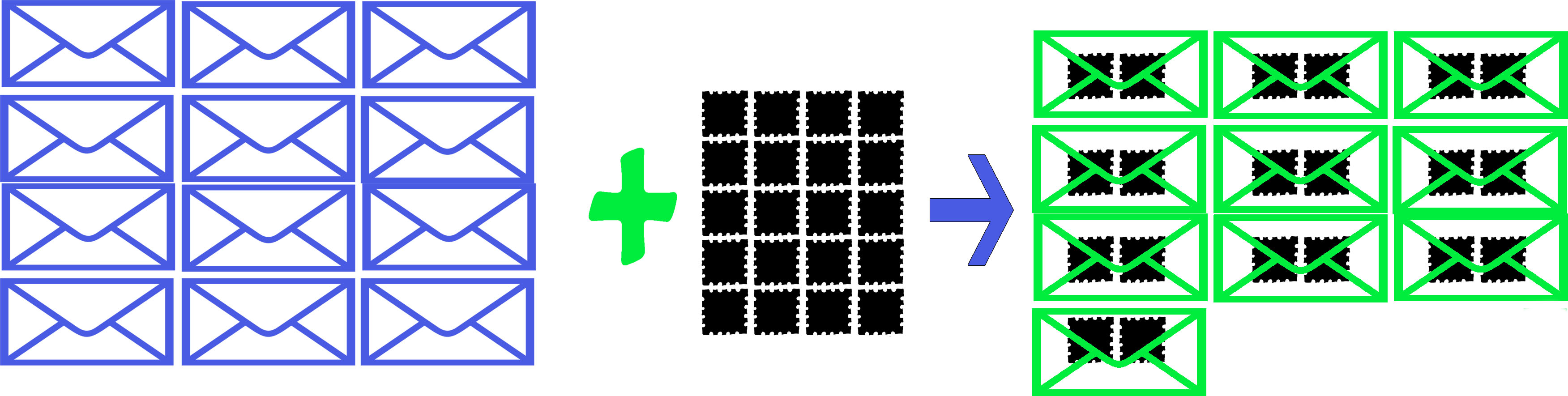
Invitations Stamps Party Invitations Sent
In this example are all the reactants (stamps and invitations) used upwards? No, and this is normally the case with chemic reactions. There is often excess of one of the reactants. The limiting reagent, the 1 that runs out get-go, prevents the reaction from continuing and determines the maximum amount of production that can be formed.
Instance iii
What is the limiting reagent in this case?
Solution
Stamps, considering there was only enough to transport out invitations, whereas there were enough invitations for 12 complete party invitations. Aside from only looking at the problem, the problem can be solved using stoichiometric factors.
12 I x (1IS 2/1I) = 12 ISii possible
20 S 10 (1IS 2/2S) = 10 IS2 possible
When there is no limiting reagent considering the ratio of all the reactants acquired them to run out at the same time, information technology is known as stoichiometric proportions.
Types of Reactions
There are 6 basic types of reactions.
- Combustion: Combustion is the germination of CO2 and H2O from the reaction of a chemical and Otwo
- Combination (synthesis): Combination is the addition of 2 or more simple reactants to grade a complex product.
- Decomposition: Decomposition is when complex reactants are broken down into simpler products.
- Single Displacement: Single displacement is when an chemical element from on reactant switches with an element of the other to form ii new reactants.
- Double Displacement: Double deportation is when 2 elements from on reactants switched with two elements of the other to grade ii new reactants.
- Acid-Base of operations: Acid- base of operations reactions are when two reactants form salts and h2o.
Molar Mass
Earlier applying stoichiometric factors to chemical equations, you demand to understand molar mass. Molar mass is a useful chemical ratio between mass and moles. The atomic mass of each private element equally listed in the periodic table established this human relationship for atoms or ions. For compounds or molecules, you have to take the sum of the diminutive mass times the number of each atom in order to determine the molar mass
Instance 4
What is the molar mass of HiiO?
Solution
\[\text{Molar mass} = 2 \times (1.00794\; thou/mol) + one \times (xv.9994\; k/mol) = 18.01528\; one thousand/mol\]
Using tooth mass and coefficient factors, information technology is possible to convert mass of reactants to mass of products or vice versa.
Example 5: Combustion of Propane
Propane (\(\ce{C_3H_8}\)) burns in this reaction:
\[\ce{C_3H_8 + 5O_2 \rightarrow 4H_2O + 3CO_2} \nonumber\]
If 200 1000 of propane is burned, how many g of \(H_2O\) is produced?
Solution
Steps to getting this answer: Since you cannot calculate from grams of reactant to grams of products you lot must catechumen from grams of \(C_3H_8\) to moles of \(C_3H_8\) then from moles of \(C_3H_8\) to moles of \(H_2O\). Then convert from moles of \(H_2O\) to grams of \(H_2O\).
- Step 1: 200 k \(C_3H_8\) is equal to 4.54 mol \(C_3H_8\) .
- Step 2: Since there is a ratio of 4:one \(H_2O\) to \(C_3H_8\), for every 4.54 mol \(C_3H_8\) there are 18.18 mol \(H_2O\).
- Pace three: Convert 18.18 mol \(H_2O\) to g \(H_2O\). 18.18 mol \(H_2O\) is equal to 327.27 g \(H_2O\).
Variation in Stoichiometric Equations
Nearly every quantitative relationship tin exist converted into a ratio that can be useful in data analysis.
Density
Density (\(\rho\)) is calculated as mass/volume. This ratio tin can be useful in determining the volume of a solution, given the mass or useful in finding the mass given the volume. In the latter example, the inverse human relationship would be used.
Volume x (Mass/Volume) = Mass
Mass ten (Volume/Mass) = Volume
Percent Mass
Percents establish a human relationship as well. A percentage mass states how many grams of a mixture are of a certain element or molecule. The percent X% states that of every 100 grams of a mixture, X grams are of the stated element or compound. This is useful in determining mass of a desired substance in a molecule.
Example 6
A substance is v% carbon by mass. If the total mass of the substance is ten grams, what is the mass of carbon in the sample? How many moles of carbon are in that location?
Solution
ten g sample x (5 chiliad carbon/100 k sample) = 0.five g carbon
0.5g carbon x (i mol carbon/12.011g carbon) = 0.0416 mol carbon
Molarity
Molarity (moles/L) establishes a relationship betwixt moles and liters. Given volume and molarity, it is possible to calculate mole or use moles and molarity to summate volume. This is useful in chemical equations and dilutions.
Example vii
How much five Chiliad stock solution is needed to prepare 100 mL of 2 G solution?
Solution
100 mL of dilute solution (one L/1000 mL)(ii mol/1L solution)(1 L stock solution/5 mol solution)(chiliad ml stock solution/1L stock solution) = 40 mL stock solution.
These ratios of molarity, density, and mass percent are useful in complex examples ahead.
Determining Empirical Formulas
An empirical formula can exist determined through chemic stoichiometry by determining which elements are nowadays in the molecule and in what ratio. The ratio of elements is determined by comparing the number of moles of each chemical element nowadays.
Instance eight: Combustion of Organic Molecules
i.000 gram of an organic molecule burns completely in the presence of excess oxygen. It yields 0.0333 mol of COii and 0.599 chiliad of HiiO. What is the empirical formula of the organic molecule?
Solution
This is a combustion reaction. The problem requires that you know that organic molecules consist of some combination of carbon, hydrogen, and oxygen elements. With that in listen, write the chemical equation out, replacing unknown numbers with variables. Do not worry nigh coefficients hither.
\[ \ce{C_xH_yO_z(g) + O_2(g) \rightarrow CO_2(one thousand) + H_2O(g)} \nonumber\]
Since all the moles of C and H in COtwo and HtwoO, respectively have to accept came from the 1 gram sample of unknown, start past calculating how many moles of each element were present in the unknown sample.
0.0333mol CO2 (1mol C/ 1mol CO2) = 0.0333mol C in unknown
0.599g H2O (1mol H2O/ 18.01528g H2O)(2mol H/ 1mol HtwoO) = 0.0665 mol H in unknown
Calculate the final moles of oxygen by taking the sum of the moles of oxygen in CO2 and H2O. This will give y'all the number of moles from both the unknown organic molecule and the O2 so you must subtract the moles of oxygen transferred from the O2.
Moles of oxygen in COtwo:
0.0333mol COii (2mol O/1mol CO2) = 0.0666 mol O
Moles of oxygen in HiiO:
0.599g H2O (1mol H2O/18.01528 k H2O)(1mol O/1mol H2O) = 0.0332 mol O
Using the Law of Conservation, we know that the mass before a reaction must equal the mass after a reaction. With this we can utilise the difference of the terminal mass of products and initial mass of the unknown organic molecule to determine the mass of the Oii reactant.
0.333mol COtwo(44.0098g COtwo/ 1mol CO2) = one.466g CO2
1.466g CO2 + 0.599g H2O - 1.000g unknown organic = 1.065g O2
Moles of oxygen in O2
i.065g O2(1mol Oii/ 31.9988g O2)(2mol O/1mol O2) = 0.0666mol O
Moles of oxygen in unknown
(0.0666mol O + 0.0332 mol O) - 0.0666mol O = 0.0332 mol O
Construct a mole ratio for C, H, and O in the unknown and separate past the smallest number.
(1/0.0332)(0.0333mol C : 0.0665mol H : 0.0332 mol O) => 1mol C: two mol H: 1 mol O
From this ratio, the empirical formula is calculated to be CH2O.
Determining Molecular Formulas
To determine a molecular formula, get-go determine the empirical formula for the compound equally shown in the department above and and then determine the molecular mass experimentally. Side by side, divide the molecular mass by the molar mass of the empirical formula (calculated by finding the sum the total atomic masses of all the elements in the empirical formula). Multiply the subscripts of the molecular formula past this respond to get the molecular formula.
Case 9
In the example above, it was determined that the unknown molecule had an empirical formula of CHtwoO.
one. Find the tooth mass of the empircal formula CH2O.
12.011g C + (1.008 k H) * (ii H) + 15.999g O = 30.026 g/mol CH2O
ii. Determine the molecular mass experimentally. For our compound, it is 120.056 g/mol.
3. Divide the experimentally adamant molecular mass by the mass of the empirical formula.
(120.056 g/mol) / (30.026 g/mol) = 3.9984
iv. Since 3.9984 is very shut to four, it is possible to safely round upwards and assume that there was a slight error in the experimentally determined molecular mass. If the respond is not shut to a whole number, there was either an mistake in the calculation of the empirical formula or a big error in the decision of the molecular mass.
5. Multiply the ratio from stride 4 by the subscripts of the empirical formula to get the molecular formula.
CH2O * iv = ?
C: 1 * 4 = 4
H: 2 * 4 = 8
O 1 * 4 = 4
CH2O * iv = CivHviiiO4
6. Check your upshot by computing the molar mass of the molecular formula and comparison it to the experimentally determined mass.
tooth mass of C4H8Oiv= 120.104 thou/mol
experimentally determined mass = 120.056 g/mol
% error = | theoretical - experimental | / theoretical * 100%
% error = | 120.104 k/mol - 120.056 grand/mol | / 120.104 k/mol * 100%
% error = 0.040 %
Instance 10: Complex Stoichiometry Problem
An apprentice welder melts down two metals to make an blend that is 45% copper by mass and 55% atomic number 26(II) by mass. The blend's density is three.15 g/L. Ane liter of alloy completely fills a mold of volume yard cm3. He accidentally breaks off a one.203 cm3 piece of the homogenous mixture and sweeps it exterior where it reacts with acid rain over years. Assuming the acid reacts with all the atomic number 26(II) and not with the copper, how many grams of H2(one thousand) are released into the atmosphere because of the amateur's carelessness? (Note that the situation is fiction.)
Solution
Footstep 1: Write a balanced equation after determining the products and reactants. In this situation, since we assume copper does non react, the reactants are only H+(aq) and Fe(s). The given production is H2(g) and based on cognition of redox reactions, the other product must be Fe2 +(aq).
\[\ce{Iron(south) + 2H^{+}(aq) \rightarrow H2(m) + Fe^{ii+}(aq)} \nonumber\]
Stride 2: Write down all the given data
Alloy density = (3.15g alloy/ 1L alloy)
10 grams of alloy = 45% copper = (45g Cu(southward)/100g alloy)
ten grams of blend = 55% iron(2) = (55g Fe(s)/100g alloy)
one liter blend = 1000cm 3 alloy
alloy sample = 1.203cm3 alloy
Footstep three: Answer the question of what is being asked. The question asks how much H2(g) was produced. Yous are expected to solve for the amount of product formed.
Pace 4: First with the compound yous know the about well-nigh and employ given ratios to convert it to the desired compound.
Convert the given amount of alloy reactant to solve for the moles of Fe(s) reacted.
1.203cm3 alloy(1liter alloy/1000cm iii alloy)(3.15g blend/1liter alloy)(55g Iron(southward)/100g alloy)(1mol Fe(s)/55.8g Atomic number 26(s))=3.74 ten ten-5 mol Fe(south)
Make sure all the units cancel out to give yous moles of \(\ce{Fe(s)}\). The higher up conversion involves using multiple stoichiometric relationships from density, percent mass, and tooth mass.
The counterbalanced equation must now be used to catechumen moles of Fe(due south) to moles of H2(g). Remember that the balanced equation'southward coefficients land the stoichiometric factor or mole ratio of reactants and products.
3.74 10 10-5 mol Fe (southward) (1mol H2(g)/1mol Fe(s)) = 3.74 x ten-v mol H2(g)
Step 5: Check units
The question asks for how many grams of H2(g) were released so the moles of Hii(g) must still be converted to grams using the molar mass of H2(m). Since there are two H in each H2, its molar mass is twice that of a single H cantlet.
molar mass = ii(ane.00794g/mol) = 2.01588g/mol
3.74 10 10-5 mol H2(g) (2.01588g H2(g)/1mol H2 (g)) = vii.53 x 10-5 1000 Hii(g) released
Problems
Stoichiometry and balanced equations make it possible to apply 1 piece of information to calculate another. There are countless means stoichiometry tin be used in chemistry and everyday life. Try and meet if you can utilise what yous learned to solve the post-obit bug.
1) Why are the following equations not considered balanced?
- \(H_2O_{(l)} \rightarrow H_{ii(grand)} + O_{2(thousand)}\)
- \(Zn_{(s)} + Au^+_{(aq)} \rightarrow Zn^{two+}_{(aq)} + Ag_{(s)}\)
ii) Hydrochloric acid reacts with a solid chunk of aluminum to produce hydrogen gas and aluminum ions. Write the balanced chemical equation for this reaction.
iii) Given a 10.1M stock solution, how many mL must be added to water to produce 200 mL of 5M solution?
4) If 0.502g of methyl hydride gas react with 0.27g of oxygen to produce carbon dioxide and water, what is the limiting reagent and how many moles of water are produced? The unbalanced equation is provided below.
\[\ce{CH4(g) + O2(g) \rightarrow CO2(one thousand) + H2o(l)} \nonumber\]
v) A 0.777g sample of an organic compound is burned completely. It produces 1.42g CO2 and 0.388g H2O. Knowing that all the carbon and hydrogen atoms in CO2 and H2O came from the 0.777g sample, what is the empirical formula of the organic compound?
References
- T. E. Dark-brown, H.E LeMay, B. Bursten, C. Murphy. Chemistry: The Key Science. Prentice Hall, January 8, 2008.
- J. C. Kotz P.M. Treichel, J. Townsend. Chemical science and Chemical Reactivity. Brooks Cole, February seven, 2008.
- Petrucci, harwood, Herring, Madura. General Chemistry Principles & Modern Applications. Prentice Hall. New Jersey, 2007.
Contributors and Attributions
- Joseph Nijmeh (UCD), Mark Tye (DVC)
Source: https://chem.libretexts.org/Bookshelves/Inorganic_Chemistry/Supplemental_Modules_and_Websites_%28Inorganic_Chemistry%29/Chemical_Reactions/Stoichiometry_and_Balancing_Reactions
0 Response to "Ap Midterm Review Station 1- Stoichiometry (Balance and State the Type)"
Postar um comentário